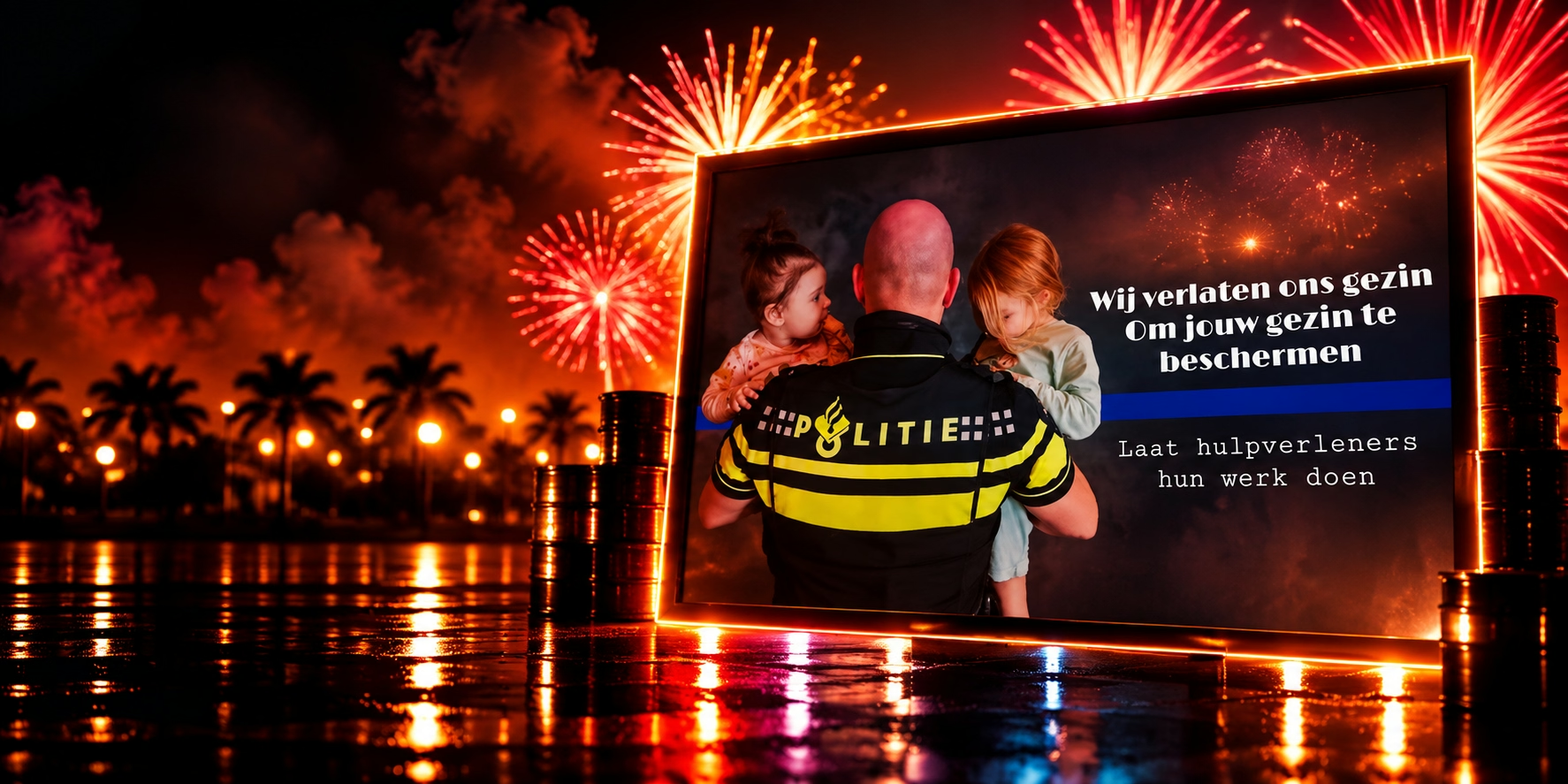
Fireworks ban: why does the law-abiding citizen pay the price?
There is a persistent lie politicians use to justify the national fireworks ban: “We must protect emergency workers.” Of course we must. Anyone with common sense agrees that ambulance crews and firefighters must be able to work in peace. Violence against emergency workers is disgusting and unacceptable. But the claim that a fireworks ban will solve it rests on a completely false assumption.
In The Hague, they act as though the entire Netherlands becomes a war zone on 31 December. The reality? Law-abiding citizens do not throw projectiles at police cars. The overwhelming majority of fireworks enthusiasts clean up their rubbish and wish officers on the street a happy New Year. The violence is not a national problem but a local crime problem. Why does the whole country receive collective punishment for the misconduct of a small group of rioters?
The familiar neighbourhoods and failed local bans
Anyone looking at evaluations from recent years sees a clear pattern. For years, things have gone wrong in exactly the same cities and the same neighbourhoods. What is more, many of the cities where emergency services have suffered the worst attacks already had a local fireworks ban. Cities such as Rotterdam and Amsterdam have already shown that a ban on paper achieves nothing. Troublemakers in the familiar problem neighbourhoods did not care in the slightest and kept throwing illegal products from abroad.
It is the world turned upside down: because the authorities cannot maintain order in a few notorious streets, they take away the tradition from citizens in the rest of the country where celebrations remain perfectly friendly.
The brick logic: the offender is the problem, not the rocket
What policymakers simply refuse to understand is that a ban does not remove aggression from the streets. The only thing a fireworks ban achieves is depriving law-abiding citizens of their legal hobby. Troublemakers on the streets will not change their behaviour because of it.
If these rioters can no longer find fireworks, their aggression and frustration will not suddenly dissolve into the night air. They will grab a brick, a paving slab, a beer bottle or a bicycle chain to throw at the police. Emergency vehicles will be damaged just as badly. The problem was never the fireworks; it is the offender. Banning fireworks only tackles a symptom while leaving the real cause – the total lack of respect and upbringing in those neighbourhoods – completely untouched.
Double standards
Citizens’ unease grows when we look at how other situations are handled. Think of the mass riots, looting and destruction surrounding Morocco’s World Cup football matches. Entire city centres were taken over, heavy fireworks were thrown at officers and emergency services were deliberately attacked. And what did the authorities do? They chose “de-escalation”. Officers had to retreat for fear of making things escalate further.
As soon as a group of troublemakers is large and aggressive enough, the authorities seem paralysed by fear. But the law-abiding citizen launching a rocket in their own front garden? They immediately face the full force of the law.
Conclusion: an act of pure weakness
The national fireworks ban is the ultimate admission of failure by the Dutch state. Because the police face enormous staff shortages and politicians lack the courage to tackle problem neighbourhoods firmly, they choose the easy route. Ban the product, and you do not have to track down the offender.
The result is that lawlessness in those particular neighbourhoods will continue – they will just as readily throw bricks or illegal products. The only change is that millions of decent Dutch people who have never hurt a fly are criminalised for their hobby. As long as the authorities avoid troublemakers but punish decent citizens, the fireworks ban is not an act of justice but an act of pure weakness.